Design Criteria
Urban areas tend to be on flat land because they generally develop alongside rivers – historically, the basis of our transport and trading networks.
Of course, once you look more closely, there are plenty of major cities built on hills. Parks help a town or city “breathe” and this Design Clinic shows ways you can light large spaces safely and comfortably.
There are two major priorities. The first is that of safety for the people using the park. Sloping ground inevitably means having steps and ramps. These must be well illuminated and guidance can be found in various documents such as the Equalities Act, BS 8300 (Design of buildings and their approaches to meet the needs of disabled people) and BS 5489 (Street lighting design either in the form of isolux lines or spot light levels.).
Never forget that vertical illumination on people’s faces is as important as the horizontal at ground level. It is always a good idea to run a quick calculation showing vertical illumination at about 1.5m above ground just to check that people can see each other clearly.
The other major priority is that of minimising light pollution. This can be done by using luminaires which do not emit any upward light. In terms of reducing sky glow, the critical zone to avoid is 0 – 30 degrees above the horizontal. Light which shines straight up, for example from a small paver, has less impact in terms of skyglow than a badly aimed streetlight.
Where the ground is terraced, you need to make sure that any sudden changes in level are clearly highlighted. This can often be achieved by a change in texture or reflectance of the ground rather than flooding the edges with extra illumination.
The views of the park that you can see in the images measures approximately 40m wide.
Colours
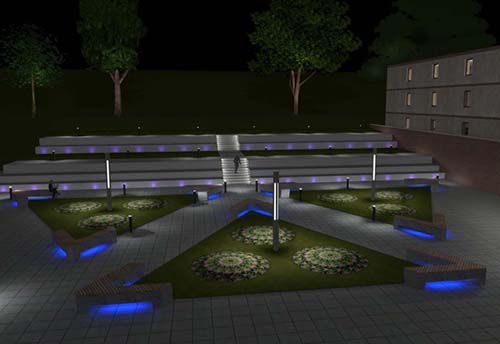
This is the most complex of the three schemes and has a lot going on. The most obvious effect is the use of colour but there is plenty more.
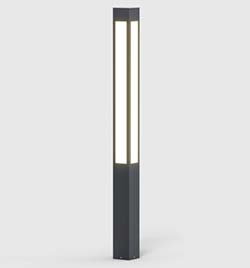
The green areas in the foreground are illuminated using pole lights. The marine grade aluminium LXL-PL17809-50W column is 4m high and has low-glare, prismatic polycarbonate, diffusers on all four sides. This diffuser highlights the grass and planted areas. It also emphasises the shape of the green. It also provides good vertical illumination which helps facial recognition.
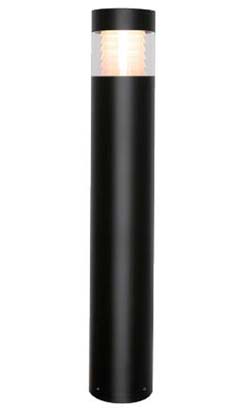
The paths at both low and high level are illuminated using 0.8-1m high BLLB9AGH0166 bollards. These can have a symmetric or pathway distribution and this enables wide spacings to be achieved.
Lighting underneath seating is a good way of providing small focal points. It also ensures the space does not collect litter or is used to hide packages. Colour is an added feature but this technique works equally well with white light.
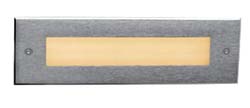
Lastly, the steps are illuminated using wall recessed RWLD1FL1014 with an frosted glass or PMMA diffuser. We have used them on each side of the 2.5m wide steps. Depending on the size and geometry of the terracing, you could use higher wattage louvered versions.
Tech Spec A:
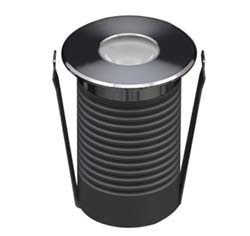
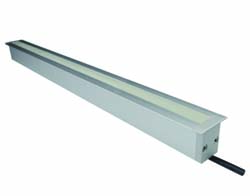
Luminaires: LXL-PL17809-50W, RWLD1FL1014, LXL-IGLWLB01, IGLB2YCR0157
Electrical load per luminaire 50W, 3-4W, 5-10W and 2-3W
 Contrasting white
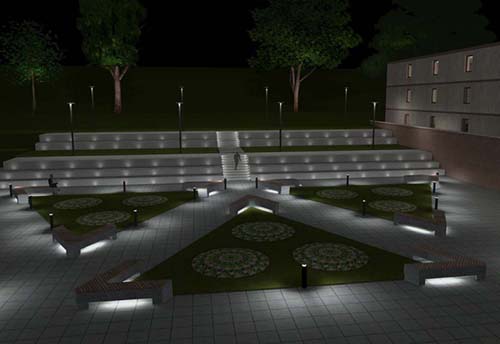
The intention here is to provide contrasting pools of white light. The most obvious is the lighting under the seating using linear LXL-IGLWLB01. This unit is normally used as an inground fixture and it is tough enough to be driven over. We used it because we liked the sharp linear lighting effect.
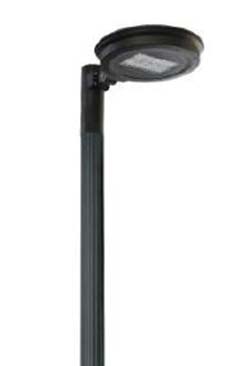
The pathways at high level use the LXL-PL17809-50W. This has an asymmetric beam with a choice of six different optical distributions. The CAD optimised optics allow for very wide spacings thus minimising the number of columns to be used.
We have used a forward throw version of the LXL-PL17809-50W on the upper levels to light the different levels on the terracing. This also clearly defines one level from another.
The terracing risers are illuminated with inground paver lights, the RWLD1FL1014. We have used a medium beam but a narrow with a sharp cut-off is also available.
Tech Spec B:
Luminaires: LXL-PL17809-50W, RWLD1FL1014, BLLB9AGH0166
Electrical load per luminaire 50W, 3-4W, 8-10W
 Simplicity itself
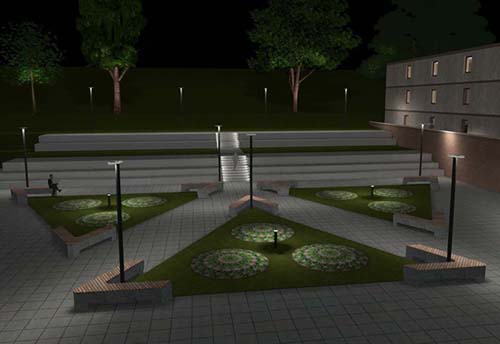
This is simplest of the options and maybe my personal favourite. You can see that there are very few luminaires used.
The seating area is clearly illuminated by the LXL-PL17809-50W and these also provide uniform lighting along the pathways. These particular units are 50W mounted at 5m and emit 5,000 lm but there is a 100W, 10,000 lumen version so you could mount it much higher.
Again, we have use the BLLB9AGH0166 bollard but this time with a symmetric distribution to illuminate the centre of the green areas.
The terracing and the pathway at lower level are again illuminated using the LXL-PL17809-50W with the asymmetric side-throw distribution.
Lighting on steps is always important an, again, we have illuminated each tread with the RWLD1FL1014 step light.
Tech Spec C:
Luminaires: LXL-PL17809-50W, RWLD1FL1014, BLLB9AGH0166
Electrical load per luminaire 50W, 3-4W, 8-10W