What Is a Pool Light? IP68 Swimming Pool Lighting Guide for Resorts, Hotels and Villas
In the discipline of premium luxury hospitality architecture and master-planned landscape design, sub-surface water features—such as infinity swimming pools, central lagoons, and
dynamic water features—function as the definitive nocturnal visual heart of the property. When darkness falls, the absence of a highly calculated, professional underwater lighting solution instantly transforms these vast water volumes into flat, ominous dark voids, severing the narrative continuity of the spatial design.
Among the spectrum of specialized outdoor architectural hardware, the
swimming pool luminaire stands as one of the most vital technical instruments available to lighting designers and MEP consultants to sculpt dramatic fluid refractions and articulate spatial luxury under the night sky.
However, specifying submersible lighting hardware demands compliance with some of the most rigid engineering criteria in the electrical manufacturing industry. Underwater luminaires operate within a severely hostile environment: enduring constant hydrostatic pressure 365 days a year, resisting aggressive chemical corrosion from oxidizing sanitizing agents or coastal sea mists, and maintaining absolute electrical safety thresholds for human immersion.
Selecting the appropriate luminaire topology, determining optical beam spreads, calculating wattage densities, and certifying metallurgical compositions are critical structural steps required to deliver an operating system lifetime exceeding 50,000 hours without systemic failure. This technical paper presents a comprehensive specification framework for professional underwater lighting installations.
Ingress Protection in Aquatic Environments: The Core of the IP68 Standard
The IP code (Ingress Protection Rating) is an internationally standardized classification framework utilized to quantify the sealing effectiveness of electrical luminaire enclosures against the intrusion of foreign solid particles and liquid moisture. This technical protocol is codified and governed globally by the International Electrotechnical Commission under the
IEC 60529 standard.
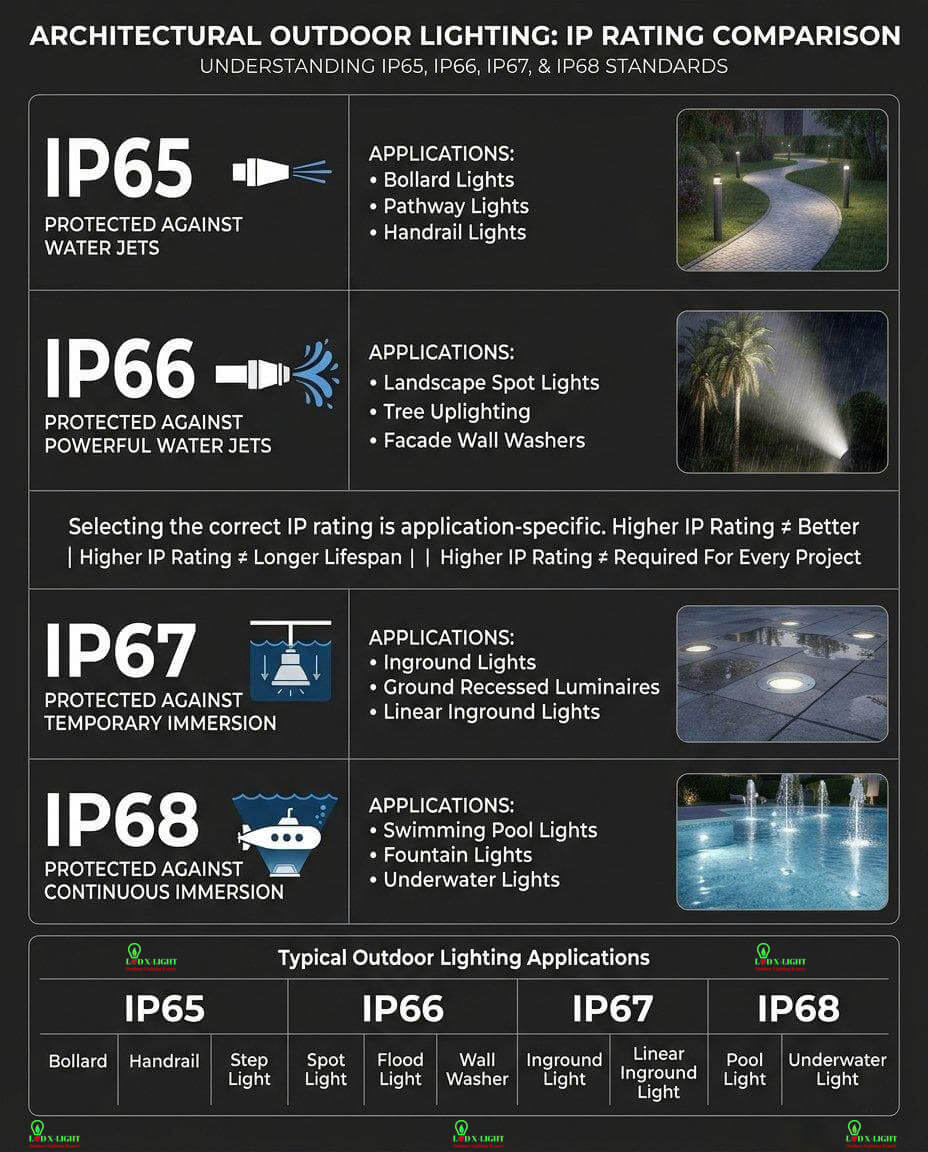
While an IP67 rating is strictly limited to temporary submersion lasting up to 30 minutes at depths not exceeding 1 meter, professional
underwater lighting networks and continuous aquatic applications
mandate an absolute IP68 rating. The luminaire enclosure must maintain complete dust exclusion (First Digit: 6) coupled with resistance to permanent deep-water submersion under hydrostatic pressure (Second Digit: 8).
The key engineering differentiator is that the luminaire must operate indefinitely under precise hydrostatic parameters defined by the manufacturer—typically involving continuous submersion at depths ranging from 1 to 3 meters.
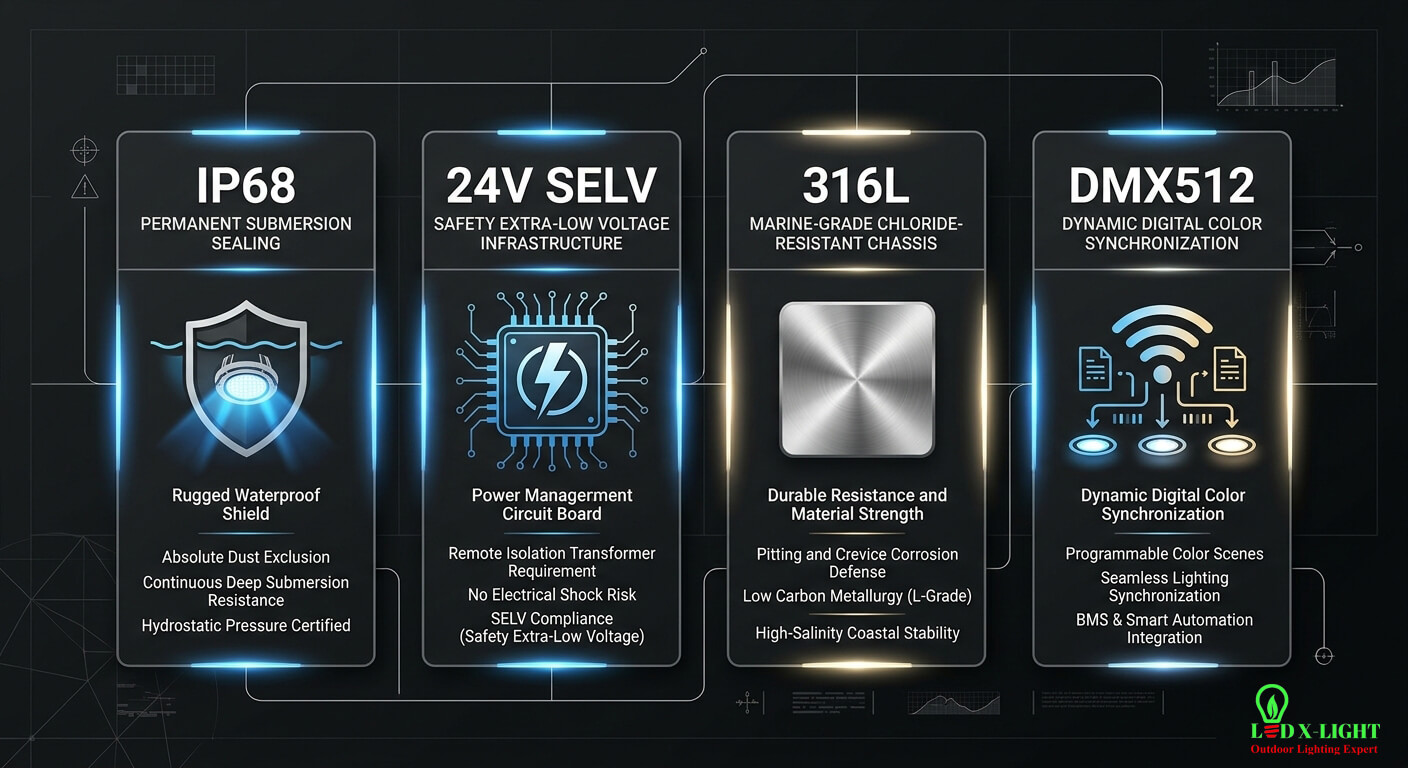
Achieving this permanent sealing tier requires rigid mechanical engineering tolerances, utilizing high-tensile vulcanized silicone compression gaskets, specialized polymer compound adhesives, and precision-compressed tempered optical glass rims bolted to a heavy-duty chassis block. This structural matrix prevents micro-permeation into the critical LED light engine chamber.
Mechanical Composition and Mandatory Engineering Standards
To survive continuous aquatic immersion, the physical construction and internal electrical infrastructure of swimming pool luminaires must comply with strict international quality codes, focusing on safety and thermal performance.
Public Safety Electrical Infrastructure: SELV (Safety Extra-Low Voltage) Compliance
This represents the absolute technical boundary regarding public safety and electrical code compliance. Submerged aquatic fixtures must never operate on direct 220V AC mains voltage. The entire underwater lighting network must execute through a remote magnetic or electronic step-down transformer positioned safely away from the pool shell, converting power to a Safety Extra-Low Voltage topology—specifically 24V DC (or 12V AC/DC).
This SELV framework guarantees that if a luminaire shell or sub-grade cable insulation is accidentally compromised by mechanical forces, any current leak into the aquatic environment remains below human perception thresholds, completely eliminating shock hazards.
Direct Liquid-Cooled Thermal Management: Hydronic Cooling Theory
A fundamental mechanical reality of professional-grade IP68 underwater luminaires is that they are engineered to execute thermal dissipation directly into the surrounding water matrix. Operational heat generated by high-output LED chip arrays transfers rapidly through the die-cast metal housing into the pool water.
This continuous hydronic cooling maintains the LED junction temperature at an optimal baseline, protecting spectral fidelity and guaranteeing a lifecycle exceeding 50,000 operating hours. Consequently, these fixtures must never be activated above-grade in dry air conditions for more than 60–120 seconds; lacking liquid cooling, rapid thermal escalation will permanently damage the LED packages and driver circuits. Above-grade dry zones must be handled by dedicated Landscape Spot Lights or exterior Bollard Lights.
Material Engineering: The Role of 316L Stainless Steel in Aggressive Environments
Beyond structural hydrostatic seals, the secondary existential threat to an underwater lighting network is aggressive chemical corrosion. The water inside five-star hospitality
swimming pools undergoes continuous chemical treatment utilizing powerful oxidizing sanitizers like chlorine, bromine, or saltwater electro-chlorination systems yielding elevated chloride ion concentrations.
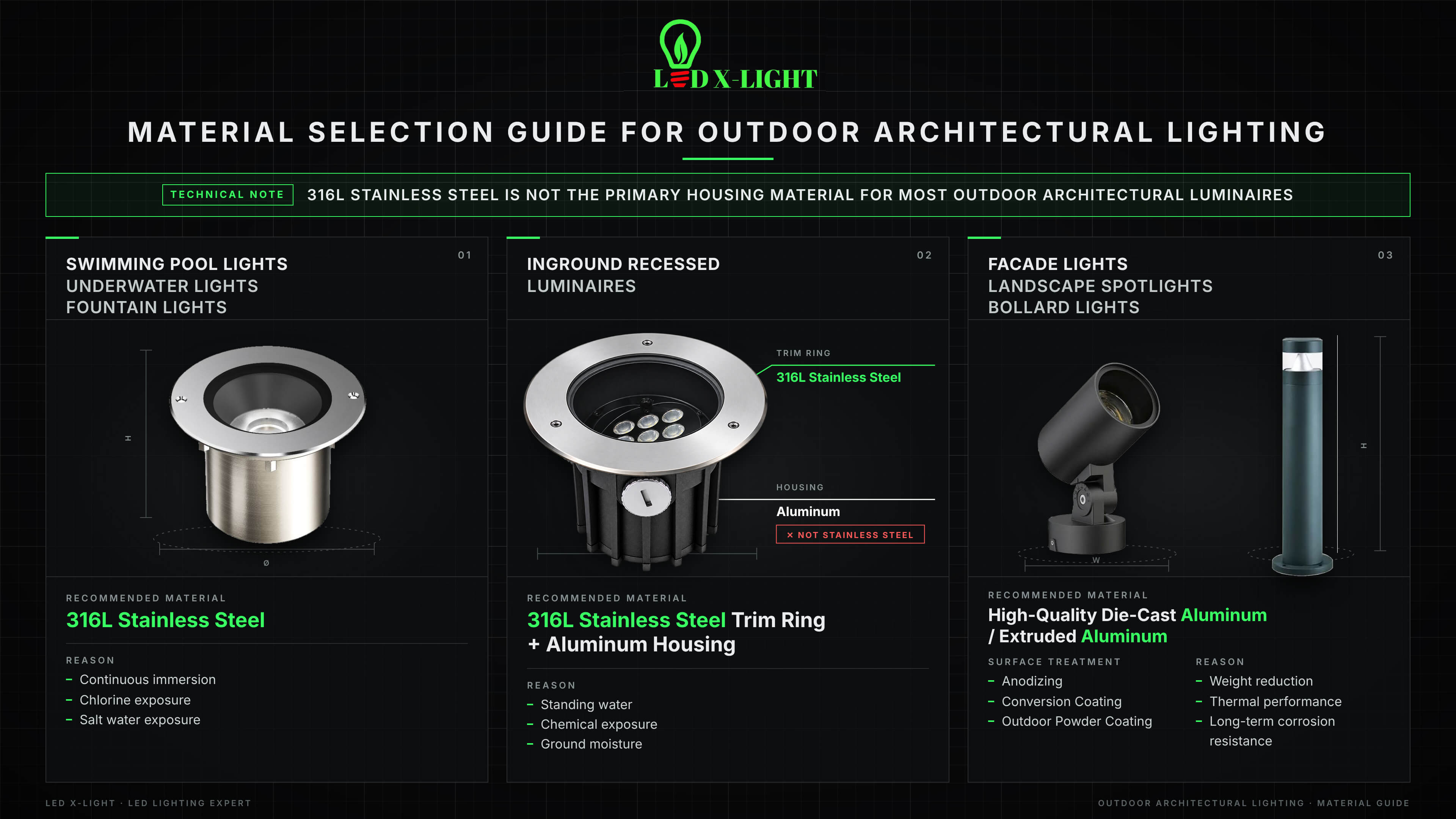
For exposed metallic structural elements—such as front trim rings, faceplates, and mechanical fastening screws—specifying standard 304-grade stainless steel is a critical error. Free chloride ions quickly bypass the passive oxide layer of 304 steel, inducing rapid pitting corrosion and crevice attacks. This chemical degradation creates unsightly rust stains that compromise luxury hospitality aesthetics, while degrading the structural integrity of the mechanical seals, allowing water to flood the internal LED chamber.
To eliminate this engineering liability, all exposed metallic components of professional underwater lights must utilize Marine-grade 316L Stainless Steel:
• Low Carbon Threshold (Carbon < 0.03%): The "L" designation indicates a low carbon configuration that prevents chromium carbide precipitation during thermal welding, maintaining structural stabilization.
• Molybdenum Integration (2%–3%): Modifies the metallurgical matrix to provide exceptional defense against chloride-induced pitting and crevice corrosion in saltwater pools and coastal resort environments.
LED X-LIGHT utilizes 316L stainless steel for exposed stainless-steel outdoor lighting components to provide enhanced corrosion resistance in coastal, hospitality and
resort environments.
 Classification and Structural Installation Methods in Professional Practice
To compile an accurate luminaire schedule, MEP consultants, project engineers, and lighting specifiers must categorize underwater fixtures based on their mechanical integration methods and intended optical performance:
Recessed / Embedded Pool Luminaires
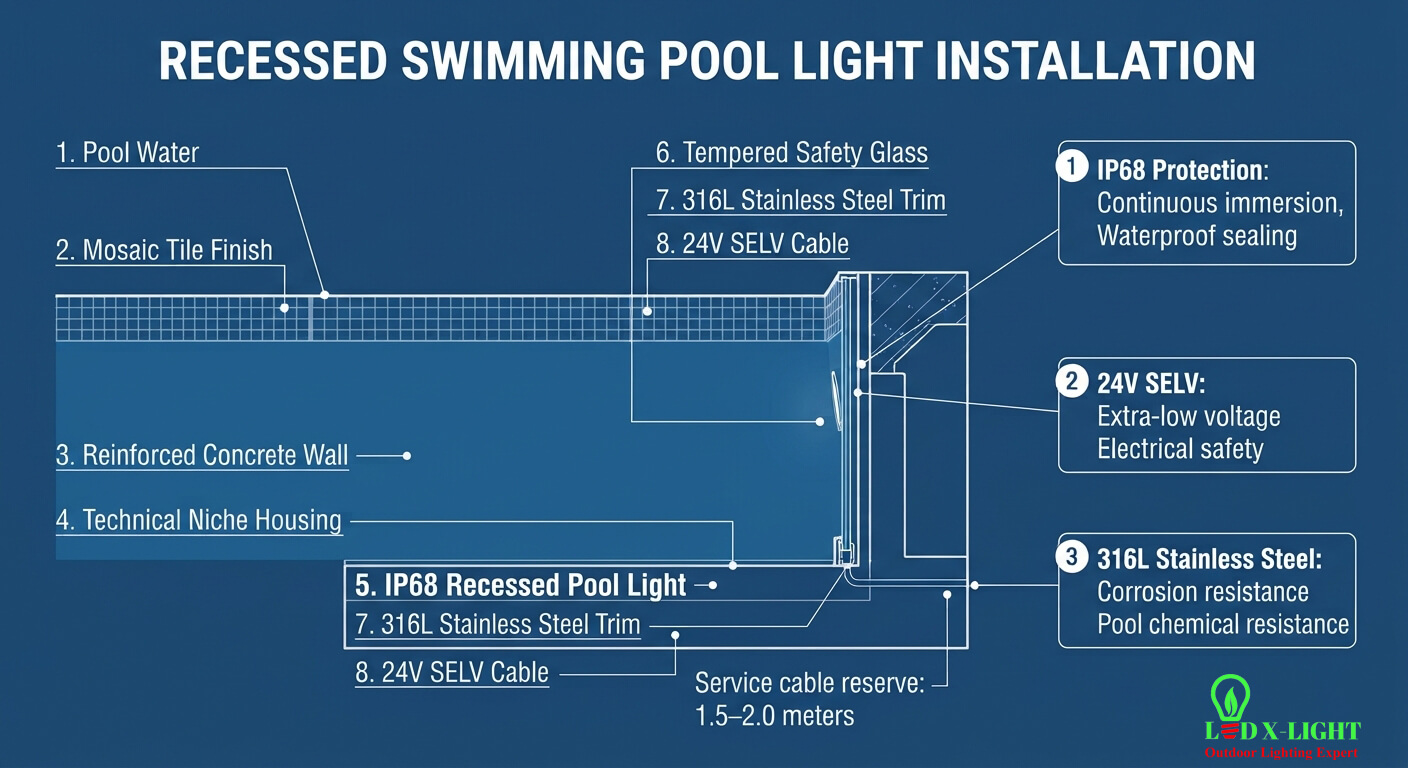
The luminaire body sits entirely within a pre-installed heavy-duty polymer blockout sleeve (Niche) cast directly into the concrete pool shell during the rough-in construction phase. Upon finish tiling, the marine-grade 316L faceplate and tempered glass lens sit flush with the mosaic or natural stone lining.
This delivers clean architectural integration, eliminates physical obstructions within the swimming lane, ensures guest safety, and protects the fixture from accidental mechanical impact. These systems are mandatory for main infinity pools, lap pools, and private villa plunge pools across premium hospitality assets.
Surface-Mounted Pool Luminaires
The fixture fastens directly onto the finish pool wall using a low-profile metallic mounting bracket system, extending outward from the wall face by 2cm to 4cm. This method streamlines site installation workflows, eliminates the need for structural concrete blockouts during rough-ins, and simplifies long-term maintenance and hardware replacement. These fixtures are primarily scheduled for commercial property retrofits, infrastructure upgrades, or architectural designs featuring thin structural pool walls.
Submersible Spotlights (Fountain Lights)
Heavy-duty, bracket-mounted adjustable projectors configured with full axial articulation (Panning/Tilting) secured onto weighted bases or sub-surface slabs. They are exclusively specified for underwater lighting networks within dynamic musical fountains, architectural water features, and ecological lagoons where narrow-beam, long-throw vertical light delivery is required to track moving columns of water.
Lighting Layout Metrics: Wattage Densities, Mounting Depths, and Beam Spreads
Sub-surface illumination requires precise optical calculations. Water has a high refractive index (1.333) compared to ambient air and absorbs light energy heavily, particularly shifting spectral bands with longer wavelengths.
1. Wattage Density and Color Rendering Guidelines
• Light-Colored Pool Finishes (White, Light Blue, Cream Mosaic Tiles): Target a standard power density allocation of 4W to 6W LED power per square meter of water surface area.
• Dark-Colored Pool Finishes (Black, Charcoal, Architectural Dark Grey): Because dark materials absorb light energy heavily, developers must increase power density allocations to 8W to 10W LED per square meter to achieve equivalent visual depth and radiance.
2. Mounting Depths and Symmetrical Pitch Spacing
Arrange the centerline of the luminaire optical block exactly 400mm to 500mm below the finish water line. Mounting fixtures too shallow (under 30cm) causes beam breakage at the surface interface, scattering stray light above the pool and creating harsh glare. Conversely, mounting too deep (over 70cm) forces the light through a thicker water layer, causing significant lumen attenuation and uneven illumination.
Distribute fixtures along the longitudinal pool walls at a pitch of 2.5 to 3.5 meters center-to-center. Position fixtures on opposing walls to cross-wash the water volume uniformly. Ensure beams project away from the primary guest view, lobby entries, or sun-lounger zones to eliminate discomforting glare.
| Application Zone |
Recommended Power |
Typical Spacing |
Optical Beam Angle |
Structural Integration |
| Villa Plunge Pools |
9W - 12W LED |
2.5m - 3.0m |
90° - 120° (Frosted) |
Flush Recessed Niche |
| Commercial Infinity Pools |
18W - 24W LED |
3.0m - 3.5m |
120° (Ultra-Wide) |
Flush Recessed DMX512 |
| Jacuzzis & Wading Pools |
3W - 6W LED |
1.5m - 2.0m |
60° - 90° (Low-Glare) |
Miniature Embedded Niche |
| Fountains & Cascades |
12W - 24W LED |
Per Nozzle Core |
15° - 30° (Narrow Accent) |
Adjustable Surface Bracket |
Critical Sub-Grade Engineering and Field Installation Practices
An estimated 95% of sub-surface luminaire failures trace back to recurring installation errors committed during the sub-grade electrical rough-in phase rather than manufacturing defects:
- Mandatory IP68 Resin-Encapsulated Junctions: The electrical splice connecting the factory-molded luminaire tail to the primary sub-grade feeding cable represents a critical point of failure. Installers must seal this joint within an industrial junction box completely filled with two-part liquid potting resin that cures into a solid dielectric barrier. Standard electrical tape wrapping will fail under continuous hydrostatic pressure; water will migrate through capillary action (wicking) directly up the copper wire strands into the sealed luminaire casing, causing short circuits regardless of the housing's seal integrity.
- Mitigating Voltage Drop across Low-Voltage Topologies: Because the electrical distribution relies on a low-voltage 24V DC infrastructure, operating amperage values are significantly higher than standard 220V mains lines. When the cable distance between the remote transformer panel and the pool shell exceeds 20 meters, substantial voltage drop occurs, causing diminished lumen outputs or visible flickering at the end of the line. MEP contractors must upsize the copper conductor cross-sections to preserve uniform brightness across the network.
- Integrating Service Cable Coils within Blockout Niches: When executing a recessed installation, contractors must leave a generous slack loop of electrical cable—measuring between 1.5 to 2.0 meters—coiled neatly inside the polymer blockout sleeve behind the luminaire body. This engineering requirement allows maintenance technicians to unbolt the faceplate and raise the entire fixture above the water line onto the pool deck for servicing or module replacement, completely eliminating the need to drain thousands of cubic meters of water from a commercial resort pool.
Our application engineering division provides dedicated specification consulting: generating precise Dialux photometrical mapping, validating layout uniformity values, and ensuring seamless electrical infrastructure integration with master building management systems (BMS) over DMX512, DALI, and 0-10V structural controls.


 304 vs 316L Stainless Steel for Outdoor, Coastal & Pool Lighting
 IP65 vs IP66 vs IP67 vs IP68: Outdoor Lighting Ingress Protection Guide
 What Is an LED Inground Luminaire? Selection Guide for Resorts, Hotels and Landscape Projects
 7 Tips about Facade lighting you must know
 A guide to outdoor lighting